
If you live west of the Trail or over in Laurel Park, you already know the Sarasota live-oak canopy is half the reason the neighborhood feels like the neighborhood. You also know what’s been wandering across your kitchen counter at 9 p.m. in May: a fat, half-inch black ant that doesn’t trail like a sugar ant and doesn’t act like a ghost ant. Those are almost always carpenter ants — and in Sarasota’s older coastal neighborhoods, they’re nesting in your trees long before they ever look at your house.
This isn’t a generic Florida-ant problem; it’s a Sarasota-coastal-oak problem. Below is why the West-of-Trail and Laurel Park footprint is different, how to tell carpenter-ant damage from termite damage (they are not the same thing), and what an honest treatment plan actually looks like.
Want a tech to come look at it before it gets worse? Request a Sarasota pest control quote and we’ll get someone on the schedule.
Why Sarasota’s coastal live-oak neighborhoods are carpenter-ant country
Drive Hillview, cut through Southside Village, roll down through Laurel Park, and you’re under a near-continuous ceiling of Quercus virginiana — coastal live oak. Big, gorgeous, often a century old, and full of dead leaders, hollow scars, and old pruning wounds. That is prime carpenter-ant habitat.
Florida carpenter ants (mostly Camponotus floridanus and a couple of cousins) do not eat wood. They excavate it. They want pre-softened, moisture-damaged wood to chew galleries into so the colony has somewhere to live. A 70-year-old live oak with a hollow co-dominant limb is basically a custom carpenter-ant condo. The sandy soil and the SWFL afternoon storm pattern keep the root zone and tree wounds damp year-round, the canopy keeps the trunk shaded and humid, and the same St. Augustine lawn that holds up to those storms also keeps mulch beds soggy along the slab. By the time you see ants on the counter, the parent colony is usually already established in a tree or stump within about 100 feet of your foundation.
Seasonal pressure
Southwest Florida pest pressure through the year
- Spring Mar–MayBuilding
Warming weather wakes colonies up — activity climbs week over week.
- Summer / rainy season Jun–AugPeak
Heat + humidity + standing water = the year’s heaviest pressure.
- Hurricane season Sep–OctSurge
Storms and flooding push pests indoors looking for dry shelter.
- Fall NovActive
Cooler nights slow things down, but activity stays well above zero.
- Winter Dec–FebLower (not zero)
Our mild winters keep many pests going year-round indoors.
Summer / rainy season & Hurricane season run hottest. Carpenter-ant foraging climbs hard once nights stay warm and the storm pattern picks up — peak calls in Sarasota run April through October.
Carpenter ants vs. other big ants — and vs. termites
The two ID mistakes I see most often on Sarasota service calls: people calling every big black ant a “carpenter ant” (some are bigheaded ants or Florida woods ants and need totally different treatment), and people calling carpenter-ant frass “termite damage.” They are not the same problem and the fix is not the same.
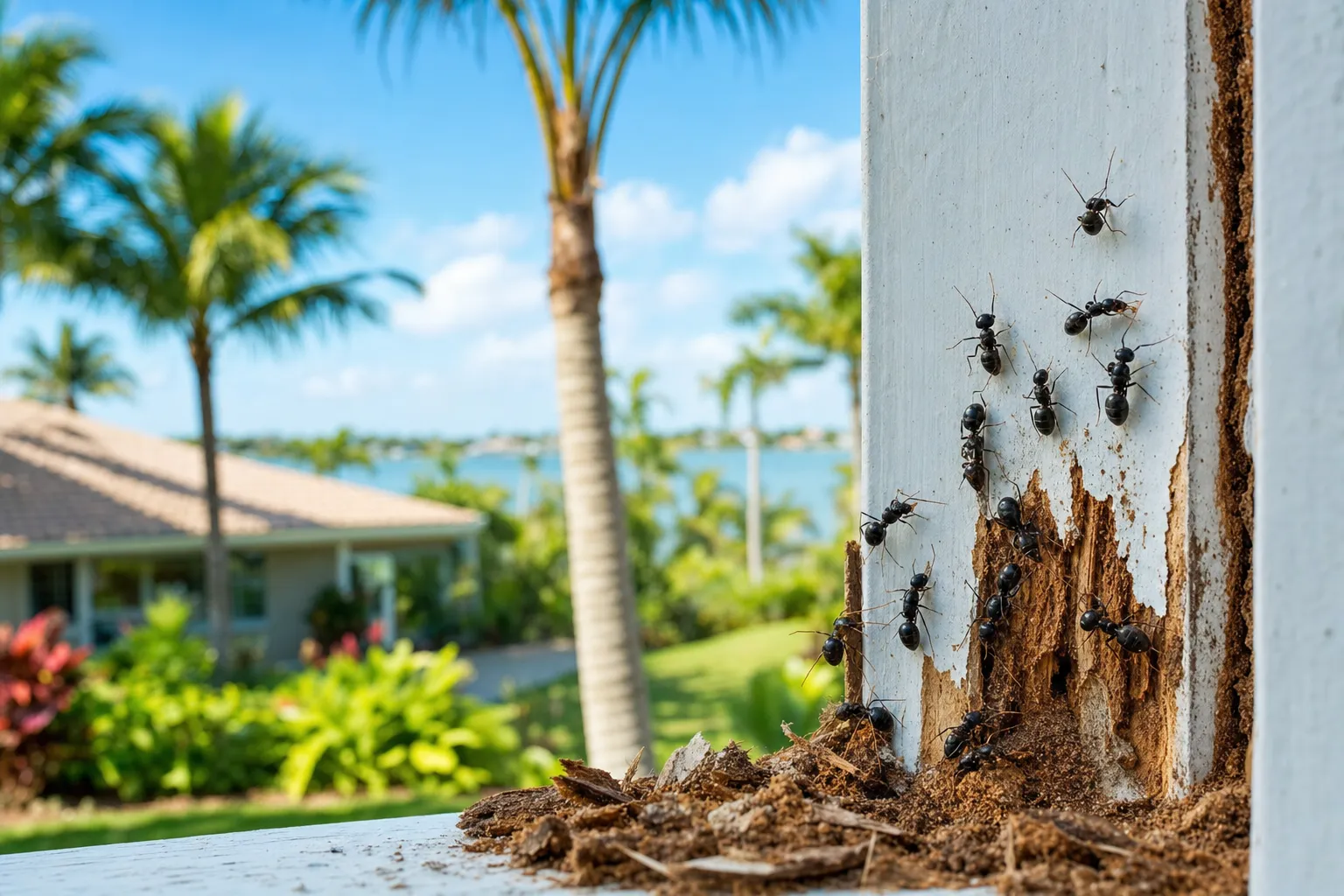
A carpenter-ant worker in your house is usually 3/8” to 1/2”, dark, with a single-segmented waist, elbowed antennae, and a smooth, evenly rounded thorax when you look from the side. They aren’t aggressive, but they bite hard if you grab one. The other tell is what they leave behind.
| What you find | Carpenter ants | Drywood termites | Subterranean termites |
|---|---|---|---|
| Debris | Sawdust-like frass with bits of ant legs/antennae mixed in | Neat six-sided pellets the size of coarse salt | No frass — mud tubes instead |
| Galleries | Smooth, clean, follow the wood grain | Rough, packed with hexagonal pellets | Mud-packed, often in damp framing |
| Where you see it | Under sinks, in soffits, around skylights, in window casings | Attic framing, door jambs, trim | Stem wall, garage slab, crawlspace pads |
| Workers | Large black/red ants, one-segmented waist | Pale, soft swarmers with equal-length wings | Pale workers rarely seen — soldiers have orange-brown heads |
Frass with insect parts = carpenter ants. Hexagonal pellets = drywood termites. Mud tubes = subterranean termites.
If you want side-by-side photos to compare with what’s on your floor, our pest library has reference shots of all three.
Pro tip: find a pile of “sawdust” with leg or antenna parts mixed in? That’s carpenter-ant frass — workers housekeeping the gallery. Clean six-sided pellets like coarse salt? That’s drywood termite frass. Pencil-wide mud tubes climbing the block stem wall? Subterranean termites. Three different bugs, three different treatment plans.
The moisture connection: roof leaks, irrigation overspray, and oak limbs on the roof
Carpenter ants follow water. In the Laurel Park bungalows and the older block-and-stucco homes west of the Trail, the same three moisture sources show up over and over on inspection:
- Roof leaks around skylights, chimneys, and valley flashings. Slow drips rot the decking from above. You don’t see it; the ants do.
- Irrigation overspray hitting siding, fascia, and window casings. Sarasota’s hard well water blasting the wall twice a day keeps that fascia damp and the paint chalky.
- Live-oak and laurel-oak limbs touching the roof or soffit. That is a literal ant bridge from the tree colony into your attic.
Trim the limbs back to a 6-foot clearance from the roofline, point the rotors away from the house, and fix the roof leak. That alone resolves a meaningful share of carpenter-ant calls in this part of Sarasota — and it makes any treatment we do last a lot longer.
Why they keep coming back after spray-and-pray
Carpenter ants are not German roaches; you cannot fog them out of the kitchen. A mature colony has a parent nest (almost always outside, often inside a hollow live-oak limb or an old stump) and one or more satellite nests inside the structure. Satellite nests have workers and pupae but no egg-laying queen — meaning you can kill 5,000 workers in your kitchen and the parent colony in the oak outside will just resupply.
If your last “treatment” was a perimeter spray, a bag of granules, and a couple cans of Raid in the cabinet, you didn’t treat the colony. You annoyed it. The ants split the satellite, the trails moved, and they came back in three weeks through a different wall.
What a Sarasota carpenter-ant inspection and treatment actually targets
A real carpenter-ant job has four steps, in this order:
- Find the parent nest. That means walking the property at dusk — every oak in striking distance, the stump in the side yard, fence posts, the firewood pile, the irrigation valve box. We’re looking for active trails after sundown, frass kicked out at the base of trees, and hollow-sounding limbs.
- Find the satellite nests inside. Moisture meter on suspect wall sections, attic walk, sound-test trim around windows and skylights, check the void behind the dishwasher and under bathroom vanities. That’s where satellites set up.
- Treat where the ants actually are. Non-repellent perimeter products and targeted indoxacarb gel baits work because foragers carry active ingredient back to the queen, instead of bouncing off a repellent barrier and re-routing through a different wall void.
- Fix the conditions. Trim the canopy, repair the roof leak, redirect the irrigation, grind the stump. Otherwise a new colony moves in next spring and you’re back where you started.
On every inspection
What a Sarasota carpenter-ant inspection looks at
- Dusk trails on tree trunks Workers move on the bark from about an hour after sunset
- Frass at the base of live oaks Sawdust-like, with leg and antenna fragments
- Hollow-sounding oak limbs Tap test on dead leaders and old scar tissue
- Soffit and fascia rot Especially where limbs touch or where flashing leaks
- Skylight and chimney flashings Slow leaks rot decking and feed satellite nests
- Under sinks and vanities Wall void above the trap is a favorite satellite spot
Six things the tech is actually looking at on a carpenter-ant inspection — not just baseboards.
Pro tip: if a pest company quotes you a one-time spray for carpenter ants and never asks about your trees or your roof, get a second opinion. That’s spray-and-pray, and it will not hold.
When it’s time to bring in a pro, the Sarasota pest control team at Waves can walk the property, ID the parent nest, and put together a plan that actually targets the colony instead of just the trail. You can see what’s covered under the WaveGuard quarterly program or browse our full pest control services for the other things we handle on these older Sarasota properties.
Frequently Asked Questions
Do carpenter ants actually eat my house?
No — they excavate wood, they don’t digest it. That’s an important distinction from drywood termites, which actually consume cellulose. Carpenter ants chew galleries into wood that’s already moisture-damaged to make room for the colony, then push the shavings (frass) out the entry hole. The long-term structural risk in a wet rafter end is real, but the mechanism is different from termite damage and the treatment is completely different.
How can I tell if I have carpenter ants or termites?
Look at the residue and the workers. Carpenter-ant workers are large and dark with a one-segmented waist and elbowed antennae; their frass looks like sawdust with insect parts mixed in. Drywood termite swarmers have two pairs of equal-length wings and leave neat hexagonal pellets the size of coarse salt. Subterranean termites build pencil-wide mud tubes up the foundation. Not sure? Snap a phone photo of the bug and the debris and we’ll ID it before the inspection.
Why do I only see the big black ants at night?
Florida carpenter ants are mostly nocturnal foragers — most active from about an hour after sunset to just before dawn, especially during Sarasota’s warm, humid stretch from April through October. If you walk into the kitchen at 10 p.m., hit the light, and see four or five large black ants on the counter, that’s normal carpenter-ant behavior. Daytime sightings usually mean the colony is already large.
Will trimming my live oaks get rid of them?
Trimming limbs back so they don’t touch the roof or soffit removes the bridge into the house and is a huge help. But if the parent nest is already inside a hollow scar or a dead leader in the tree, trimming alone will not kill the colony. The reliable fix is treatment plus trimming plus moisture correction — not any one of those by itself.
Are carpenter ants worse in West of Trail and Laurel Park than newer Sarasota neighborhoods?
In our experience, yes. The mature live-oak canopy and the older wood-framed bungalows give carpenter ants more nesting options than a 2015 block home on a cleared lot in eastern Sarasota County. That doesn’t make newer neighborhoods immune — it just means the older coastal-oak zip codes call about big black ants noticeably more often.
Carpenter ants in a Sarasota live-oak neighborhood are not a one-can-of-spray problem. Find the parent nest, dry out the satellites, and keep the canopy off the roof, and you can actually keep them out. Ready to stop chasing them around the counter at 10 p.m.?
Request your Sarasota carpenter-ant quote and we’ll come look at the property — or check ballpark numbers on the pest control calculator before you call.
About the author: Adam Benetti is the founder and lead technician (FDACS license JB351547) with 12 years working Southwest Florida homes. More on his author page.